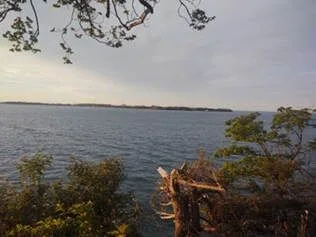
Lake Erie, born from the glaciers millennia ago, hosts diverse ecosystems on its shorelines, and on the scattering of islands that are housed within its waters. These islands are home to numerous species, found deep below the surface of the water and ice, soaring above its waves, swimming between the islands, and crawling across the land. One species, the Lake Erie Watersnake (LEWS), is a conservation success story, the 23rd species ever delisted from the Federal List of Endangered and Threatened Wildlife. This work involved countless community partners, engagement from the public, and was spearheaded by amazing individuals, including "The Island Snake Lady," or Dr. Kristin Stanford. Though I did not know it at the time, the first person I met on South Bass Island, was an award-winning conservation biologist, a staple of the island community, and someone I am honored to have called a colleague and a friend.
Dr. Stanford coordinates multiple conservation and education programs related to LEWS, efforts that have shaped the lives of people and animals alike. I had the chance to see her in action, and to learn more about these remarkable animals. The LEWS, found only on the islands in the western basis of Lake Erie, was nearly decimated by human action, specifically the purposeful killing of them due to human fear and persecution. Only through protective measures have we seen a rebound, though threats still exist, including Snake Fungal Disease (SFD).
So what work is being done, and how can you help? Every year a research team completes a population census, scanning PIT (Passive Integrated Transponder) tags, tagging new individuals, swabbing for SFD, measuring snout vent length, and more. PIT Tags are a valuable tool injected into the individual, that can be scanned to gain records or individual identifications from a species. Requiring no external power source, they are a great tool for long-term monitoring. This team, composed of current researchers, and volunteers from years past, showcases the legacy of learning by Dr. Stanford, and those who led this effort before her.
On paper this looks extremely neat and tidy, but field work is dirty, fast paced, highly variable and of course, fun. LEWS, when scooped up for research purposes, tend to bite, and when grabbing a whole group at a time, it means the potential for multiple bites. While their bite itself does not hurt greatly, they do have an anticoagulant in their saliva, meaning bites look a lot worse than they feel. A bunch of tiny pin pricks in your hands or arms, and you look like you've walked through a wall of thorns.
When the bite does not deter them, they then musk. This defense mechanism releases a foul-smelling substance used to deter predators, and that of a LEWS can clear a room. As most of their diet includes fish, including the invasive Round Goby which they help to control, the odor is imbedded with the scent of fish gone bad, among other things. None of this though is a hinderance for the trained researcher, especially Dr. Stanford.
Snakes can be found basking in the summer sun, or under snake mats, specifically designed ground covering to provide them a place to rest. By overturning these mats, we could then see and catch the snakes for processing. Some mats had no snakes, some had multiple individuals all scattering in different directions. Researchers would dive chest deep into the water, crawl under bushes and logs, and return soaking wet, coated in mud and debris, but with a smile on their face, and a snake in hand, a chance for new data, and to understand how the population is doing, and where SFD may be spreading.
So, on World Snake Day, take the time to remember the importance of snakes, and to protect them. Often vilified in media and stories, these animals provide valuable ecosystem services, controlling rodent populations, or in the case of the LEWS, acting as a barrier to invasive species. Take the time to observe their movements and behaviors. Provide them the space to live, by leaving brush piles, rocks, and logs for them to hibernate in. Avoid the use of harsh chemicals on lawns and gardens. The most important lesson is one I learned on the islands, and from Dr. Stanford, and that is to "Respect the Snake."